Static vs. Digital: What Actually Changes in Your Building When a Tenant Moves


Every tenant move makes a static directory wrong the moment it happens, and wrong directories cost tenants business.
When a tenant relocates to a new floor or a new occupant moves in, a physical panel becomes a liability immediately. Visitors follow outdated listings to the wrong suite; the front desk absorbs the overflow.
For property managers across a portfolio, one CMS update propagates consistently to every building; no per-asset reprint budget, no variation in tenant experience between towers.
See what a digital building directory would look like in your lobby
A tenant confirms their new floor. You update the lease. Then someone looks up at the lobby directory and it still shows the old suite.
Reprinting a static panel takes days, sometimes weeks, and costs money you did not budget for this quarter. While you wait, the tenant’s clients walk in, check the board, and head to the wrong floor.
This is a recurring problem for property managers and portfolio teams who handle buildings with any meaningful turnover. A digital building directory; often referred to as a digital directory, though it does considerably more than that; removes the reprint cycle entirely. A staff login, a few edits, and the board reflects reality within minutes.
Below, we cover how that update process actually works, what the gap costs your tenants, and what else becomes possible once the directory is connected.
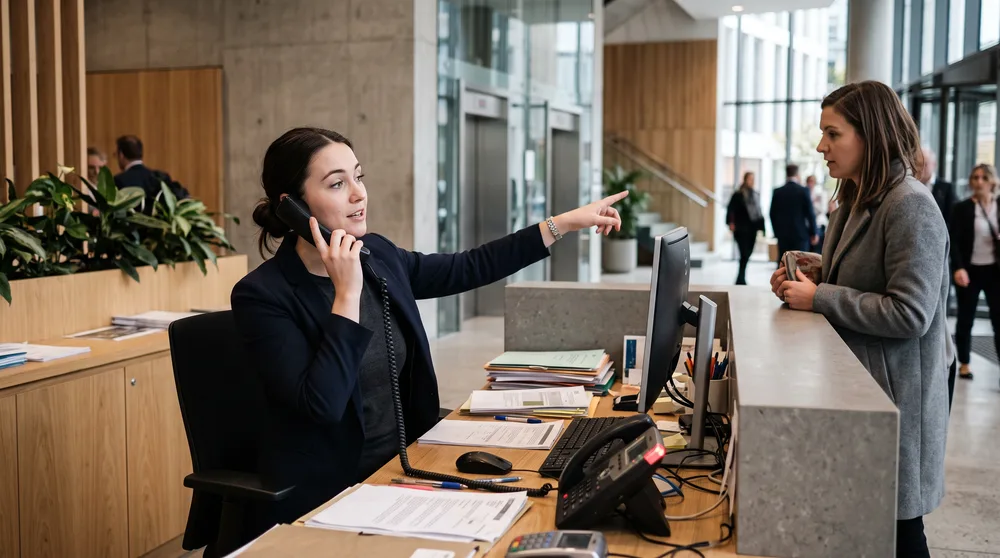
When a tenant vacates or moves to a different floor, the static directory in your lobby becomes wrong the moment they hand back their keys. A physical panel; whether engraved acrylic, push-letter, or printed insert; requires a work order, materials procurement, and in most cases a vendor visit or facilities labour to remove and replace lettering. That process routinely runs days to weeks, not hours.
During that window, the directory actively misleads visitors. A client arriving for a meeting on the 12th floor, directed by the panel to the 8th, either calls the front desk or leaves. That call volume lands on building staff; that confusion lands on the tenant trying to run a business.
In a multi-tenant office building with normal annual churn: five, eight, twelve lease events per year, those individual costs compound. Labour, materials, and third-party installer fees repeat every cycle. Directors managing a portfolio of several buildings, particularly those operating under national account standards for managers such as GWLRA, Colliers, or BGO, absorb those costs across every asset simultaneously, with no efficiency between buildings.
A CMS-driven digital directory shifts content control to the property management team directly. A permissions model allows a property manager or administrative coordinator to add a tenant name, update a suite number, and publish the change without vendor involvement. The change appears on the lobby screen the same day, often the same hour.
That speed has a practical implication for leasing: a tenant can have suite identification on day one of occupancy, before any physical signage is fabricated. For a leasing tour, that first impression: a lobby screen showing current, accurate tenants; signals an actively managed building in a way a half-empty push-letter panel does not.
Some digital directory platforms also integrate with access-control or leasing management systems, pulling tenant roster data directly so the directory updates when the lease record does.
A common assumption is that a physical engraved panel in the lobby meets accessibility requirements by default. It does not.
The U.S. Access Board’s ADA Guide for Signs specifies that interior signs providing direction to or information about interior spaces must meet visual requirements but are not required to be tactile. An engraved panel that has been partially modified, has inconsistent contrast from an older section, or uses a non-compliant typeface fails those requirements regardless of its format.
Digital directories introduce a separate compliance layer. ICT (information and communications technology) with closed functionality — such as a lobby kiosk — must be operable without requiring the user to attach or install assistive technology other than personal headsets or other audio couplers, per Section 402 of the ICT Accessibility Standards. And if the interface runs on a browser-based CMS, WCAG 2.2 applies to web content on any kind of device, including kiosks. A properly specified digital directory addresses both layers at deployment.
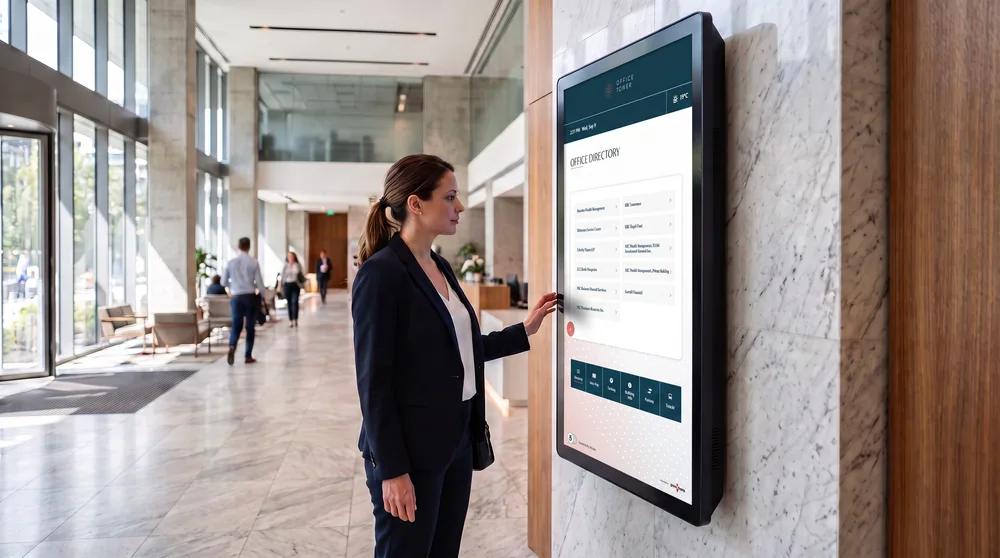
A digital directory is not a one-to-one replacement for a panel. The same screen can display amenity hours, event listings, emergency notifications, and building announcements on a scheduled or triggered basis. Wayfinding maps and floor plans reduce the “where exactly is suite 410?” question that currently lands on the front desk.
For a portfolio director, a single CMS platform governing content across multiple buildings means one governance structure, one training program, and one vendor relationship; rather than coordinating separate physical sign vendors building by building.
youRhere offers a no-obligation walkthrough showing exactly how a digital directory would sit in your space: no quote required to start that conversation.
A static directory that lags tenant moves is a recurring cost absorbed silently by building staff, incoming tenants, and their clients. Every transition that runs days instead of minutes erodes the lobby experience your leasing team works hard to project.
Going digital changes the economics at the transaction level: one staff member updates the CMS, the display reflects it immediately, and front-desk misdirection calls drop without a service ticket or vendor visit. For portfolio managers holding assets under national account standards, that consistency becomes replicable across every building on the same platform, not negotiated building by building.
The broader implication is structural: as tenant churn accelerates in flex-lease environments, the directory is no longer background infrastructure. It’s an operational dependency. Buildings that treat it that way will carry a measurable advantage in tenant retention conversations before the lease renewal even starts.