
Static vs. Digital: What Actually Changes in Your Building When a Tenant Moves

Digital building directory cuts tenant change costs

Every tenant move makes a static directory wrong the moment it happens, and wrong directories cost tenants business.

When a tenant relocates to a new floor or a new occupant moves in, a physical panel becomes a liability immediately. Visitors follow outdated listings to the wrong suite; the front desk absorbs the overflow.

  • A static engraved panel is not automatically ADA-compliant just by existing; per the U.S. Access Board’s ADA Guide Chapter 7, interior signs providing direction to or information about interior spaces must meet visual requirements but are not required to be tactile, meaning a reprinted plaque still requires verification before reinstallation.
  • Reprinting and installer scheduling typically runs days to weeks, leaving an accuracy gap your tenants’ clients walk straight into.
  • Misdirected visitors call the front desk, pulling staff from higher-value work and creating exactly the dated lobby experience that loses leasing tours.
  • A digital building directory publishes updates from the CMS within the hour; no fabrication lead time, no installer booking, no compliance re-review of physical materials.
  • Once digital, the same screen serves wayfinding, floor maps, and building announcements; capabilities a static panel cannot add without full replacement.

For property managers across a portfolio, one CMS update propagates consistently to every building; no per-asset reprint budget, no variation in tenant experience between towers.

See what a digital building directory would look like in your lobby

A tenant confirms their new floor. You update the lease. Then someone looks up at the lobby directory and it still shows the old suite.

Reprinting a static panel takes days, sometimes weeks, and costs money you did not budget for this quarter. While you wait, the tenant’s clients walk in, check the board, and head to the wrong floor.

This is a recurring problem for property managers and portfolio teams who handle buildings with any meaningful turnover. A digital building directory; often referred to as a digital directory, though it does considerably more than that; removes the reprint cycle entirely. A staff login, a few edits, and the board reflects reality within minutes.

Below, we cover how that update process actually works, what the gap costs your tenants, and what else becomes possible once the directory is connected.

a front desk receptionist juggling a phone call and giving directions to a visitor, papers piling up.

How static directories break and what that costs you

When a tenant vacates or moves to a different floor, the static directory in your lobby becomes wrong the moment they hand back their keys. A physical panel; whether engraved acrylic, push-letter, or printed insert; requires a work order, materials procurement, and in most cases a vendor visit or facilities labour to remove and replace lettering. That process routinely runs days to weeks, not hours.

During that window, the directory actively misleads visitors. A client arriving for a meeting on the 12th floor, directed by the panel to the 8th, either calls the front desk or leaves. That call volume lands on building staff; that confusion lands on the tenant trying to run a business.

In a multi-tenant office building with normal annual churn: five, eight, twelve lease events per year, those individual costs compound. Labour, materials, and third-party installer fees repeat every cycle. Directors managing a portfolio of several buildings, particularly those operating under national account standards for managers such as GWLRA, Colliers, or BGO, absorb those costs across every asset simultaneously, with no efficiency between buildings.

Who controls the update, and how fast is It?

A CMS-driven digital directory shifts content control to the property management team directly. A permissions model allows a property manager or administrative coordinator to add a tenant name, update a suite number, and publish the change without vendor involvement. The change appears on the lobby screen the same day, often the same hour.

That speed has a practical implication for leasing: a tenant can have suite identification on day one of occupancy, before any physical signage is fabricated. For a leasing tour, that first impression: a lobby screen showing current, accurate tenants; signals an actively managed building in a way a half-empty push-letter panel does not.

Some digital directory platforms also integrate with access-control or leasing management systems, pulling tenant roster data directly so the directory updates when the lease record does.

What your current signage may not actually satisfy

A common assumption is that a physical engraved panel in the lobby meets accessibility requirements by default. It does not.

The U.S. Access Board’s ADA Guide for Signs specifies that interior signs providing direction to or information about interior spaces must meet visual requirements but are not required to be tactile. An engraved panel that has been partially modified, has inconsistent contrast from an older section, or uses a non-compliant typeface fails those requirements regardless of its format.

Digital directories introduce a separate compliance layer. ICT (information and communications technology) with closed functionality — such as a lobby kiosk — must be operable without requiring the user to attach or install assistive technology other than personal headsets or other audio couplers, per Section 402 of the ICT Accessibility Standards. And if the interface runs on a browser-based CMS, WCAG 2.2 applies to web content on any kind of device, including kiosks. A properly specified digital directory addresses both layers at deployment.
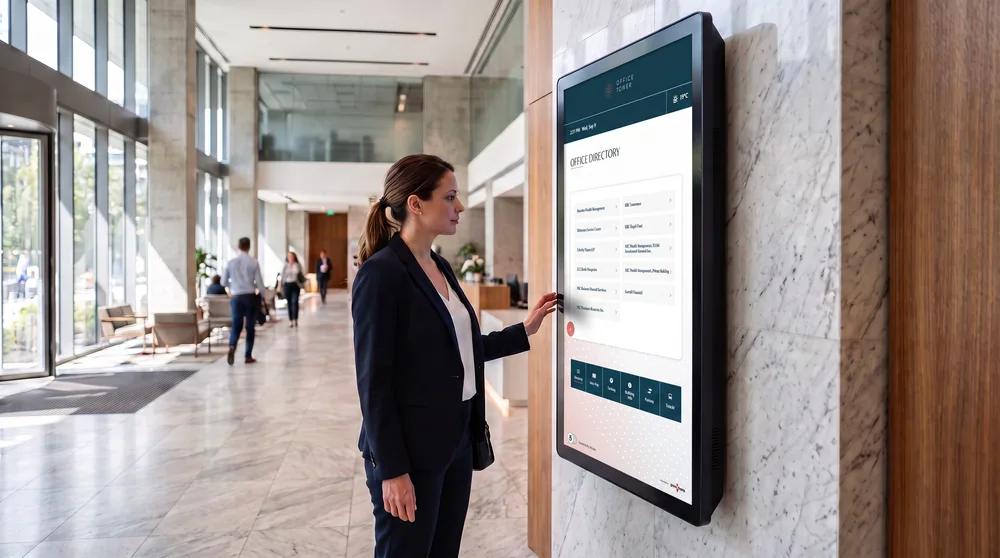
a sleek digital directory screen with a glowing tenant list and floor map, a visitor calmly reading it.

Beyond names: what the screen can actually do

A digital directory is not a one-to-one replacement for a panel. The same screen can display amenity hours, event listings, emergency notifications, and building announcements on a scheduled or triggered basis. Wayfinding maps and floor plans reduce the “where exactly is suite 410?” question that currently lands on the front desk.

For a portfolio director, a single CMS platform governing content across multiple buildings means one governance structure, one training program, and one vendor relationship; rather than coordinating separate physical sign vendors building by building.

See what this looks like in your lobby

youRhere offers a no-obligation walkthrough showing exactly how a digital directory would sit in your space: no quote required to start that conversation.

A static directory that lags tenant moves is a recurring cost absorbed silently by building staff, incoming tenants, and their clients. Every transition that runs days instead of minutes erodes the lobby experience your leasing team works hard to project.

Going digital changes the economics at the transaction level: one staff member updates the CMS, the display reflects it immediately, and front-desk misdirection calls drop without a service ticket or vendor visit. For portfolio managers holding assets under national account standards, that consistency becomes replicable across every building on the same platform, not negotiated building by building.

The broader implication is structural: as tenant churn accelerates in flex-lease environments, the directory is no longer background infrastructure. It’s an operational dependency. Buildings that treat it that way will carry a measurable advantage in tenant retention conversations before the lease renewal even starts.

Start the conversation today

5 Reasons Why Commercial Buildings are Upgrading to Digital Directories

It’s clear that building lobbies are ever-important in today’s world. Businesses are upgrading to digital directory systems to make a lasting impression. These systems look modern and sophisticated, unlike the outdated paper-based directories of the past. They provide real-time info about commercial tenants, maps, and announcements. Plus, they can integrate with other building management solutions.

Innovative features like touchscreens, voice assistants, and mobile applications have changed the way people interact with building lobbies. Visitors can easily search for anything they need, as well as get personalized recommendations. This convenience reflects positively on the businesses housed within the building.

  1. Convenience: Exploring how digital directory systems provide convenience for visitors by offering easy navigation and access to information.

Digital directory systems make it a cinch for visitors to find what they need. Just a few taps on the interactive touch screen and they’re good to go! No more getting lost in complicated layouts or wasting time searching. Plus, these systems offer more than directions – they can display relevant info like upcoming events and announcements.

Customization is key too. Digital displays can be tailored to match the lobby’s branding and aesthetics, so visitors get to enjoy state-of-the-art tech and an elegant atmosphere. Finding your way around doesn’t have to be a hassle anymore.

  1. Efficiency: Discussing how digital directory systems improve efficiency by reducing manual labor and streamlining the process of managing building directories.

Digital directory systems revolutionize building lobbies, reducing labor costs and making management easier. They automate manual tasks and streamline processes, eliminating the need for paper-based directories or constant reprinting.

Plus, it’s user-friendly – property managers or receptionists can update information with just a few clicks, without any technical know-how.

Digital signage also enhances communication and information dissemination. It captivates visitors’ attention with eye-catching visuals and engaging multimedia content.

Furthermore, these systems provide search functionalities that help visitors easily find businesses or individuals with keywords or categories. This saves time for both visitors and staff.

In a tech-driven world, digital directory systems are essential for achieving optimal efficiency in building lobbies. Get on board and experience how these innovative systems can empower your lobby space and elevate the visitor experience.

  1. Cost-effectiveness: Highlighting the cost-saving benefits of digital directory systems compared to traditional methods like printed directories or hiring staff for assistance.

Digital directory systems offer cost-saving benefits compared to traditional methods. They are revolutionizing building lobbies around the world. These systems reduce printing costs, eliminate staffing expenses, and make updating easy. Plus, they increase efficiency and productivity.

Customization is a bonus! Digital directory systems can be tailored to match the building’s branding and aesthetics. Interactive features like touchscreen interfaces and QR code scanning create an engaging experience.

It’s clear that digital directory systems are essential for businesses seeking efficient ways to enhance their lobbies. They provide cost-saving benefits, ease of use, and real-time updates. More and more buildings are upgrading to these modern solutions.

  1. Customization: Showing how digital directory systems allow for customization and flexibility in displaying information, branding, and adding additional features like advertising or announcements.

Digital directory systems offer a lot of customization. These allow building lobbies to show info in a personalized way. Not just directories and floor plans, but logos, ads, and announcements too!

Let’s look at the features:

  • Information Display – Tailor the system to show info like directories and floor plans.
  • Branding – Add logos, colors, and identity to the system.
  • Advertising – Offer space for ads of tenants or local businesses.
  • Announcements – Easily add updates to keep visitors informed.

Plus custom layouts, fonts, and colors. This means building owners can create a great experience for their visitors.

Digital directory systems have come a long way. In the past, directories were static and required manual maintenance. Now, lobbies are interactive and provide real-time info.

By using digital directory systems‘ customization, lobbies enhance their functionality while promoting their brand and providing useful info. It reflects not only tech advances but also the importance of creating immersive experiences.

  1. Enhanced user experience: Explaining how digital directory systems enhance the overall user experience through interactive interfaces, touchscreen capabilities, and real-time updates.

Digital directory systems are packed with amazing features! Interactive interfaces, touchscreen capabilities, and real-time updates make it easy to find what you need.

Interactive interfaces allow you to search for locations, view floor plans, and look for extras with just a few taps. No more static signs!

Touchscreen capabilities make it even easier. Scrolling, zooming, and customizing preferences are a breeze. Plus, no complex instructions or help from staff is needed.

Real-time updates are the biggest perk. No surprise changes or outdated info – just the latest info when you need it. Users feel informed, empowered, and impressed.

Come experience the future of digital directory systems! Unlock secret doors and explore virtual wonderlands.

Frequently Asked Questions

Q: What are digital directory systems?
A: Digital directory systems are advanced technology-based solutions implemented in building lobbies to provide a modern and interactive way of displaying directory information and guiding visitors within the premises.

Q: Why are building lobbies upgrading to digital directory systems?
A: There are several reasons for this upgrade:
1. Enhanced Visitor Experience: Digital directory systems provide a user-friendly interface that allows visitors to quickly find the information they need, enhancing their overall experience.
2. Improved Efficiency: These systems offer real-time updates and easy-to-use search features, saving time for both visitors and staff members.
3. Cost-effective Solution: Digital directory systems eliminate the need for printed directories, reducing printing and maintenance costs.
4. Increased Flexibility: Building management can easily update and customize the content displayed on the digital directory systems, adapting to the changing needs of the occupants.
5. Modern and Innovative Image: By upgrading to digital directory systems, building lobbies project a modern and technologically advanced image, leaving a positive impression on visitors.

Q: What features do digital directory systems typically offer?
A: Digital directory systems typically offer features such as:
– Interactive touchscreens for easy navigation.
– Search functionality to quickly locate specific offices, facilities, or individuals.
– Building maps and directions to guide visitors to their desired destinations.
– Accessible information on building amenities, services, and events.
– Integration with other building management systems, such as access control or visitor management.

Q: Can digital directory systems handle dynamic information updates?
A: Yes, digital directory systems are designed to handle real-time information updates. They can display changes in office locations, contact details, upcoming events, or any other details that may need to be updated regularly.

Q: Do digital directory systems require internet connectivity to function?
A: Digital directory systems may require internet connectivity for initial setup, software updates, or to fetch real-time data. However, some systems can also operate offline by storing the necessary information locally.

Q: Are digital directory systems compatible with various building sizes and designs?
A: Yes, digital directory systems are highly customizable and can be tailored to fit the unique needs of different buildings, regardless of their size or architectural design. The systems can be installed in both small and large lobbies, integrating seamlessly with the building aesthetics.

Leveraging digital directories for improved commercial property management 

Leveraging digital directories for improved commercial property management 

A general good practice within any business is effective communication. Studies reveal that on average, companies lose $62.4 million annually due to inadequate communication.  

A primary method of communication within buildings is through its directory solutions. Traditional building directories have long been the resource used to communicate necessary info to guests. However, they are proving to be less effective with the emergence of digital directories.   

What are digital directories? 

As a form of digital signage, digital directories are growing in popularity as navigational tool that is a budget-friendly and innovative alternative to traditional building directory boards. With this display system, property managers and building owners are provided with additional flexibility to update relevant information in real-time to create a welcoming experience for guests.  

Their ability of digital directories to attract attention and improve retention makes them an instrumental addition for commercial and residential property owners as an enticing, versatile, and simple resource to fulfill building occupants’ navigational needs. Due to their appealing and engaging nature, these display systems can also be utilized to showcase other useful information such as local events, news, weather, and even ads.   

What are the benefits of digital directories?  

With 93% of business leaders deeming effective communication to be the backbone of the business, digital information systems are meeting this standard as they continue to advance over time. Their expansion has revealed numerous advantages that manual directories can’t provide.  

Effortlessly update  

Digital building directories are significantly easier to update than traditional directories, allowing organizations to consistently provide accurate and current information. This seamlessness enables property managers to offer deeper and more meaningful engagement with captivating visuals. For additional simplicity, these systems can be updated across multiple directories at once, improving the efficiency of information dissemination in a timely fashion.  

Financially friendly 

With conventional directories, on average it can cost $400 to update with new information, making it a more expensive option in the long run. Digital directories typically only require the upfront costs of purchasing and installing, boosting your company’s return on investment over the years. With these savings, additional funds can be directed toward other necessities in your building.  

Time-saving 

Implementing a digital signage system removes the need to manually update information as it changes – which can take up to three weeks with a traditional board –  saving the company time and resources. This enables guests to access current information to orient themselves throughout the property with ease, reducing wait times by 35 percent, and giving them control over their experiences.  

Attractive and engaging 

Digital directories optimize the use of visual aids and graphics to make the content more conversational and reduce confusion, all while modernizing your building. With various colors, fonts, and other features to make them more enticing, their aesthetic appeal can be improved to provide a great first and lasting impression. This can help to reassure tenants and guests that you are running your business responsibly.  

Actively and successfully communicating with, and informing occupants in, your building are primary drivers for client satisfaction and loyalty. When executed correctly with the right signs, digital building directories will add tremendous value by creating an enhanced, more personalized experience for both guests and tenants. Remember, well-informed clients are happy clients.